


Las zonas de distancia en el lenguaje corporal son más que un simple espacio vacío
Las personas son muy sensibles cuando se trata de sus zonas de distancia — su espacio personal. Respetar el espacio personal de los demás puede aumentar tu credibilidad y generar confianza mutua en la comunicación.
Con la información de este artículo, puedes comprender mejor cómo las personas dividen su territorio. Puedes reconocer dónde tu presencia es bienvenida — y dónde no lo es — y actuar en consecuencia.
Al observar cuidadosamente la distancia personal que otros mantienen contigo (y la orientación de su cuerpo), puedes medir el nivel de confianza y apertura que sienten hacia ti.
Comencemos con algunos antecedentes sobre la persona que dividió el espacio personal en zonas.
Antecedentes de Edward T. Hall
Antecedentes de Edward T. Hal
Edward T. Hall (1914–2009) fue un antropólogo estadounidense que desarrolló el concepto de proxémica. Investigó cómo dividimos la distancia personal, cómo influye la cultura en ella y la diferencia entre espacio personal y territorio. Realizó numerosos estudios y observaciones interculturales.
Concluyó que existe una relación directa entre el estatus social y la distancia física entre las personas. Esto significa que, si percibes a alguien como parte de tu círculo social, literalmente prefieres mantenerlo a una cierta distancia — fuera de tu espacio más íntimo, pero lo suficientemente cerca como para considerarlo un amigo.
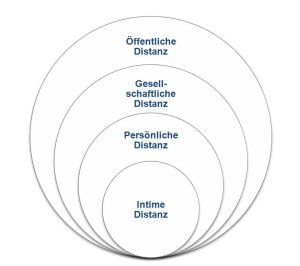
Hall dividió la distancia personal que mantenemos con los demás en cuatro zonas principales.
Estas zonas actúan como “burbujas de reacción”. Cuando entras en una zona específica, desencadenas automáticamente ciertas reacciones psicológicas y físicas en la otra persona.
Ten en cuenta: Estas zonas son pautas generales. Varían según muchos factores — especialmente el contexto cultural. No te centres en medidas exactas. Comprende la idea principal y cómo se aplica dentro de tu cultura.
Las cuatro zonas de distancia
Zona de distancia pública

Esta es la “burbuja” más externa y suele ser mayor a 3,6 metros (12 pies).
Esta zona se utiliza para hablar en público o comunicarse con grandes grupos. Resulta cómodo dirigirse a grandes audiencias desde cierta distancia — casi como si se hablara a una sola entidad.
También es cómoda para la audiencia — pueden verte (y con suerte escucharte) bien.
Esta zona también es adecuada para observar a otros sin interactuar. Por ejemplo, si alguien te parece atractivo y lo miras desde la distancia, puede ser aceptable — incluso halagador. Pero acercarte y mirar fijamente puede resultar amenazante.
Zona de distancia social

Este espacio oscila entre 1,2 y 3 metros (4–10 pies).
Es la zona más neutral y cómoda para conversaciones con personas que no conoces bien.
Ejemplos típicos:
Vendedore
Empleados de banco
Proveedores de servicios
A veces esta distancia se reduce — especialmente cuando se está sentado. Por lo general, esto ocurre porque existe una barrera (escritorio, mesa, documentos, portátil, etc.). Esta barrera ayuda a mantener la comodidad psicológica mientras permite una interacción más cercana.
En las culturas del sur, la distancia social suele ser menor que en las culturas del norte. Por ejemplo, en algunos países de Oriente Medio, los vendedores desconocidos pueden situarse más cerca de lo que esperas — lo cual es normal allí.
Zona de distancia personal

Oscila entre 60 cm y 1,2 metros (2–4 pies).
Este espacio está reservado para amigos y familiares — personas que conoces y en quienes confías. Es cómodo para conversar, dar la mano o intercambiar gestos.
Incluso dentro de esta zona, la distancia varía según el grado de agrado y cercanía emocional. Cuanto más te gusta alguien, más cerca te sitúas.
Evita acercarte demasiado y demasiado rápido, ya que puede resultar invasivo. Pero acercarte dentro de límites aceptables puede señalar agrado y generar conexión.
Esto crea un ciclo positivo:
Ellos perciben que te agradan
Les agrada que les agrades
Empiezan a apreciarte más
Zona de distancia íntima

Zona de distancia íntima
Oscila entre 0 y 60 cm (0–2 pies).
Este espacio está reservado para las personas más cercanas a ti:
Pareja
Familia
Amigos cercanos
Esta zona — especialmente los primeros 15 cm — se siente como una extensión de nuestro cuerpo. Cuando alguien entra en este espacio, nuestro cerebro activa automáticamente una reacción de lucha o huida.
Si la persona es de confianza → nos relajamos y disfrutamos de la cercanía..
Si no → nos ponemos a la defensiva y tratamos de recuperar la comodidad.
A veces, algunas personas invaden esta zona intencionalmente como una demostración de poder — por ejemplo, durante interrogatorios o tácticas de intimidación.
Otra posible interpretación de entrar en este espacio puede ser el interés sexual (o un interés sexual fingido utilizado para manipulación).
Zonas de distancia íntima en multitudes
¿Qué ocurre en situaciones de mucha gente? Ascensores, autobuses, conciertos, largas colas…
Aunque nos sentimos incómodos, no entramos en pánico. ¿Por qué?
Porque sabemos que no tenemos elección — y los demás tampoco.
Nuestro cerebro resuelve esto “deshumanizando” ligeramente a los desconocidos — es decir, los ignoramos de forma subconsciente para protegernos.
Comportamientos típicos:
Evitar el contacto visual
Expresiones faciales neutras
Movimiento o gestos mínimos
Por eso los espacios concurridos suelen sentirse fríos e impersonales.
Romper el hielo
Si eres aventurero, intenta hacer contacto visual y sonreír en situaciones con mucha gente. Los resultados varían:
Algunas personas pueden mostrarse confundidas o incómodas.
Otras pueden devolverte la sonrisa.
Ejemplo:
Hace años, estaba en una cabina de teleférico con mi mejor amigo. Empezamos a cantar una canción conocida. Al principio, la gente nos miraba fijamente. Después de unos 10 segundos, algunos se unieron. Cuando llegamos arriba, muchas personas ya estaban tarareando — y el ambiente era increíblemente positivo.
Conclusión
Ahora conoces el concepto central de la proxémica — dividir la distancia personal en zonas.
No lo confundas con el territorio.
Espacio personal = una “burbuja” a tu alrededor que influye en las reacciones.
Territorio = lugares y objetos que consideras tuyos (casa, silla, teléfono, etc.), incluso cuando no estás presente.
Nuestros seminarios y programas de formación mejoran significativamente tus habilidades de comunicación — ayudándote a tener éxito tanto en el ámbito profesional como en el personal. Hoy en día, una comunicación eficaz es una de las herramientas más importantes para progresar en la vida y en los negocios.